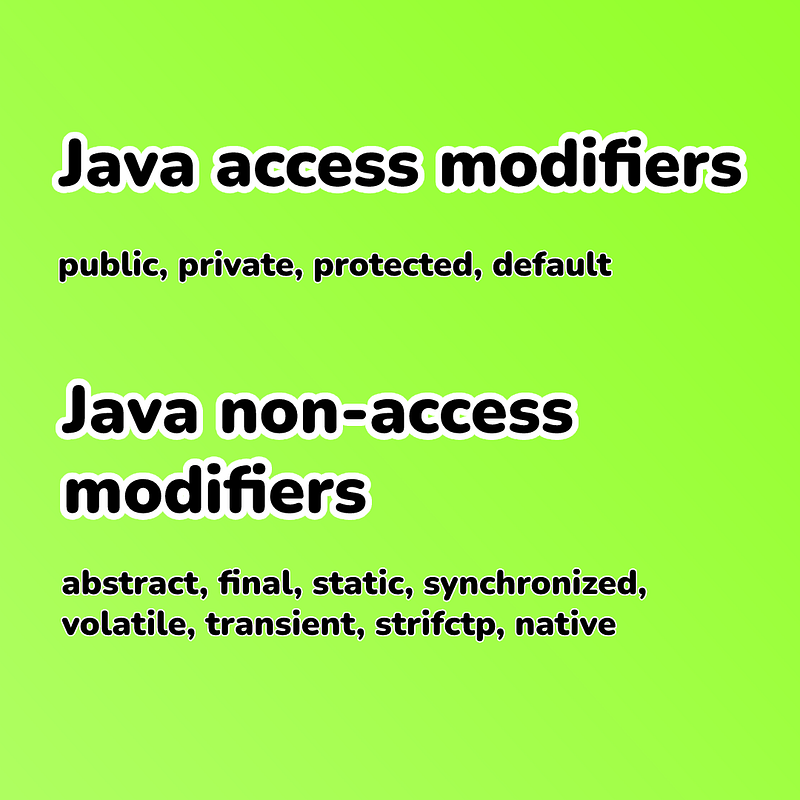
We’re familiar with access modifiers however, have you ever heard of Java’s non-access modifiers?
abstract— This modifier is used to create an abstract class or method that cannot be instantiated directly. An abstract class must be extended by a subclass that provides concrete implementations of its abstract methods.
final: This modifier is used to create a constant variable, method, or class. If a variable is defined as final, it cannot be changed after initialization. If a method is final, it cannot be overridden, also final classes cannot be extended by any subclass.
static— This modifier is used to create a class-level variable or method. Static members can be accessed without creating an object of the class.
synchronized: This modifier is used to make a method thread-safe by ensuring that only one thread can access it at a time.
volatile: This modifier is used to indicate that a variable is stored in main memory, so it’s read and written from/to main memory instead of the CPU cache.
transient: If you don’t want to serialize a variable you should use this. Transient variables are typically used for temporary or non-persistent data.
strictfp— This modifier guarantees the same floating-point calculations in any environment. Useful for precise calculations in financial or scientific applications.
native— This modifier indicates that a method will be implemented in languages other than Java (e.g., C, C++).
resource: